Industry Knowledge
How Epoxy Resin 128 and E-51 Resin Are Evaluated for Industrial Applications
Liquid Epoxy Resin 128, commonly identified as E-51 Epoxy Resin, 618 Epoxy Resin, or YD-128 Epoxy Resin in different markets, is widely evaluated according to its chemical consistency, processing behavior, and suitability for downstream formulations. For buyers, the practical value of a resin grade is not determined by the product name alone. Key parameters such as epoxy equivalent weight, viscosity, color, hydrolyzable chlorine, inorganic chlorine, softening behavior, and moisture content can directly influence formulation stability and final-product performance.
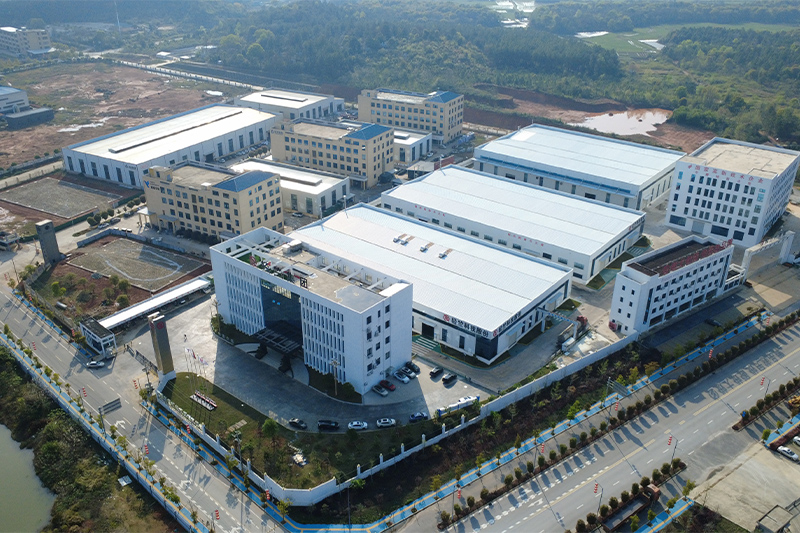
For Jiangxi Qingzhu Technology Co., Ltd., the development of Liquid Bisphenol A Epoxy Resins is closely connected with the company's broader focus on intelligent and environmentally friendly products. Qingzhu has invested substantially in production and R&D and has introduced advanced production equipment from both domestic and international sources. These investments support the company's effort to improve the consistency and functional stability of epoxy resin products rather than simply increasing production volume.
Why the same epoxy resin grade can behave differently
Even when two suppliers describe their materials as Epoxy Resin 128, differences in raw-material control, purification, manufacturing conditions, and quality inspection may lead to different viscosity or curing behavior. This is particularly important when the resin is used with curing agents, reactive diluents, fillers, pigments, or reinforcing materials. A stable resin should therefore be assessed against a consistent technical specification and application requirement.
- Check epoxy equivalent weight when calculating curing-agent dosage.
- Compare viscosity when the resin is intended for casting, coating, adhesive, or composite processing.
- Review color requirements when appearance is important in transparent or light-colored formulations.
- Evaluate chlorine and moisture indicators when electrical insulation, adhesion, or long-term reliability is critical.
Choosing Liquid Bisphenol A Epoxy Resins According to Processing Requirements
Liquid Bisphenol A Epoxy Resins are not necessarily selected simply because they have a high mechanical strength after curing. The more practical approach is to match resin characteristics with the manufacturing process. A relatively low-viscosity formulation may be preferred where good flow and impregnation are required, while controlled viscosity and reactivity can become more important for coatings, structural adhesives, electronic encapsulation, and composite materials.
Qingzhu's ongoing R&D direction focuses on improving epoxy resin variants while maintaining product quality and production stability. As a high-tech enterprise integrating new-material production, packaging-barrel manufacturing, optical lens processing, and epoxy resin R&D and production, Jiangxi Qingzhu Technology Co., Ltd. can approach resin development from both material and practical manufacturing perspectives.
| Application consideration |
Important resin characteristics |
Practical concern |
| Coatings |
Viscosity, color, curing compatibility |
Flow, leveling, adhesion, surface appearance |
| Adhesives |
Epoxy equivalent weight, viscosity, purity |
Mixing, wetting, bonding strength, curing consistency |
| Electrical materials |
Purity, moisture, ionic or chlorine-related indicators |
Insulation reliability and long-term stability |
| Composite materials |
Viscosity, wetting ability, curing response |
Fiber impregnation, void control, processing efficiency |
A useful way to compare suppliers
When comparing E-51 Epoxy Resin from different suppliers, purchasing teams should request the same technical indicators and test conditions rather than comparing viscosity or appearance alone. A consistent testing method makes it easier to identify whether differences originate from the resin itself or from measurement conditions. This approach is particularly useful for high-volume manufacturing where small variations can accumulate into formulation or production problems.
Why Viscosity Control Matters in YD-128 Epoxy Resin Formulation
Viscosity is one of the most practical parameters when working with YD-128 Epoxy Resin. It influences pumping, metering, mixing, wetting, coating thickness, impregnation, and the ability of a formulation to release trapped air. A resin with suitable viscosity can reduce the need for excessive adjustment with reactive diluents, although the final formulation must always be optimized according to the specific application and curing system.
For Jiangxi Qingzhu Technology Co., Ltd., improving resin functionality means paying attention to the relationship between production conditions and downstream processing. Qingzhu has built fully automated advanced workshops and assembled a professional team dedicated to product improvement and innovation. Such production infrastructure is particularly relevant when manufacturing liquid resin grades that require stable batch-to-batch characteristics.
Processing factors that should be monitored
- Storage temperature can affect viscosity and handling behavior.
- Extended exposure to unsuitable temperatures may influence product stability.
- Moisture control is important for applications where electrical or mechanical reliability is required.
- Mixing equipment and shear conditions can affect the apparent behavior of resin formulations.
- The compatibility between resin, curing agent, accelerator, filler, and other additives should be verified through application testing.
Understanding 618 Epoxy Resin Through Epoxy Equivalent Weight and Formulation Design
For Liquid Epoxy Resin 128 and commonly referenced 618 Epoxy Resin grades, epoxy equivalent weight is more useful than simply looking at the product name when determining the stoichiometric relationship with a curing agent. The epoxy equivalent weight represents the amount of resin corresponding to one equivalent of epoxy functionality. In practical formulation work, this value helps formulators calculate an appropriate curing-agent quantity and establish a reproducible starting formulation.
A simplified calculation can be expressed as: required resin mass divided by epoxy equivalent weight gives the approximate epoxy equivalent. The curing-agent requirement can then be determined according to the curing agent's active hydrogen equivalent weight or supplier-recommended formulation ratio. Actual formulations should still be validated through curing tests because catalysts, accelerators, fillers, reactive diluents, temperature, and humidity can influence the final result.
Qingzhu's emphasis on R&D is particularly relevant to this type of formulation optimization. Rather than treating 618 Epoxy Resin as an isolated commodity, Jiangxi Qingzhu Technology Co., Ltd. focuses on improving resin quality, functionality, and stability. Its investment in new-material production and advanced automated workshops provides a foundation for continuous process refinement.
Practical formulation checks
- Confirm the supplier's epoxy equivalent weight before recalculating curing-agent dosage.
- Use the actual technical specification of the batch rather than relying solely on a generic grade name.
- Evaluate viscosity after additives are introduced, not only before formulation.
- Confirm gel time, hardness development, adhesion, and thermal performance under actual processing conditions.
Quality Control Points for Liquid Epoxy Resin Production
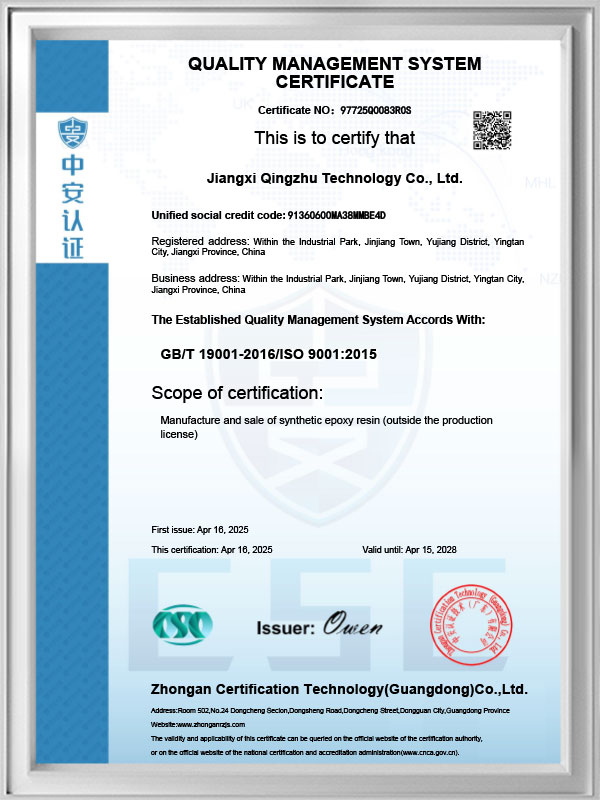
Consistent Liquid Bisphenol A Epoxy Resins require more than final-product inspection. Raw-material consistency, reaction control, purification, filtration, temperature management, storage, packaging, and batch testing can all influence the final material. For industrial customers, a reliable supplier should be able to maintain stable specifications across repeated production batches and provide technical documentation that supports incoming-quality control.
Jiangxi Qingzhu Technology Co., Ltd. has made substantial investments in production and R&D and has introduced world-class production equipment from domestic and international sources. Qingzhu's fully automated advanced workshops are designed to strengthen production consistency, while its professional technical team works on improving existing products and developing enhanced variants. This combination is important for applications where resin properties need to remain stable over long production cycles.
| Quality item |
Why it matters |
| Epoxy equivalent weight |
Supports accurate formulation and curing-agent calculation. |
| Viscosity |
Affects pumping, mixing, coating, impregnation, and processing efficiency. |
| Color |
Important for transparent, decorative, and light-colored applications. |
| Chlorine-related indicators |
Can be important for demanding electrical and high-reliability applications. |
| Moisture |
Helps maintain predictable processing and curing behavior. |
| Batch consistency |
Reduces formulation adjustments and production variability. |
How an Environmentally Focused Epoxy Resin Manufacturer Can Add Value
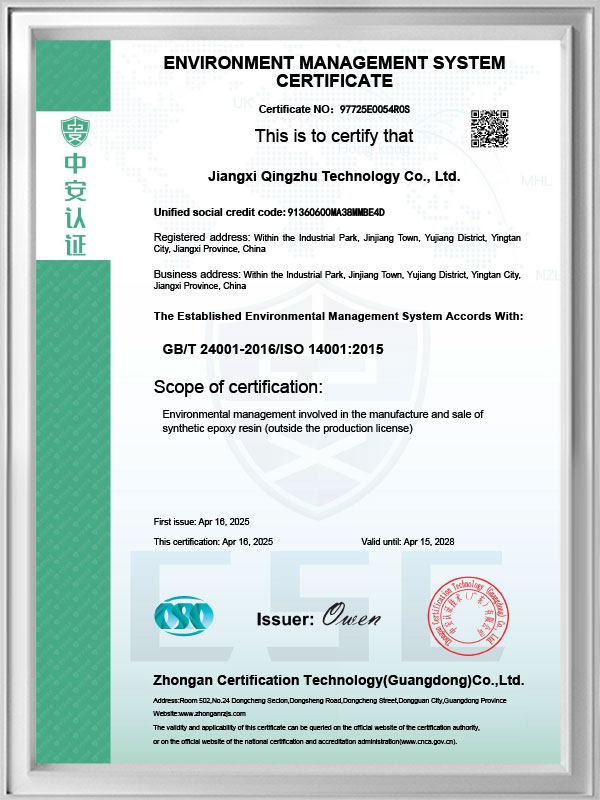
Environmental considerations are increasingly connected with material selection, manufacturing efficiency, waste reduction, and process safety. For epoxy resin manufacturers, an environmentally responsible approach does not simply mean describing a product as green. It involves improving production efficiency, controlling emissions and waste, optimizing raw-material utilization, and developing formulations that meet application requirements without unnecessary processing complexity.
Qingzhu is positioned around intelligent and environmentally friendly products, with environmental protection at the core of its development strategy and innovation-driven R&D as an important means of achieving product improvement. Jiangxi Qingzhu Technology Co., Ltd. has also developed a broader high-tech business structure covering new materials, packaging barrels, optical lens processing, and epoxy resin R&D and production. Its subsidiaries have annual turnover exceeding RMB 1 billion, reflecting the company's broader operating scale and rapid development.
For customers evaluating E-51 Epoxy Resin, YD-128 Epoxy Resin, or other Liquid Bisphenol A Epoxy Resins, this broader manufacturing background can be relevant when assessing long-term supply capability. A supplier with established production infrastructure, dedicated R&D resources, automated workshops, and a quality-focused technical team may be better positioned to support continuous improvement and customized application requirements.
What buyers can evaluate beyond the product specification
- Whether the manufacturer has stable and scalable production capacity.
- Whether production equipment and automation support consistent batch quality.
- Whether the supplier maintains ongoing R&D rather than relying only on established grades.
- Whether environmental protection is incorporated into production and product-development practices.
- Whether technical teams can provide application-oriented support for formulation and process optimization.
Improving Epoxy Resin Selection Through Application-Based Testing
A technical data sheet is an important starting point, but application testing remains necessary when replacing an existing resin or introducing a new Liquid Epoxy Resin 128 grade. Even a resin with similar nominal specifications may interact differently with a curing system, filler, pigment, substrate, or processing environment. Small differences in viscosity or reactivity can become significant when the material is used in automated production.
A practical qualification process can begin with laboratory-scale mixing, followed by viscosity and curing evaluation, adhesion or mechanical testing, and finally a controlled production trial. Jiangxi Qingzhu Technology Co., Ltd. can apply its R&D and manufacturing experience to this type of product-development process, while its commitment to quality and environmental protection supports the continued refinement of epoxy resin products.
For buyers searching for Epoxy Resin 128, E-51 Epoxy Resin, 618 Epoxy Resin, or YD-128 Epoxy Resin, the most useful approach is therefore to evaluate the complete combination of specification, batch consistency, production capability, R&D support, application performance, and environmental manufacturing practices. With its focus on intelligent and environmentally friendly products, advanced production infrastructure, and continuous investment in epoxy resin R&D, Jiangxi Qingzhu Technology Co., Ltd. is working to develop higher-quality and more stable resin solutions for industrial applications.



 English
  русский
  عربى
عربى 



 +86-15257130679
  Qingzhu Industrial Park, Yuanqu Avenue, Industrial Park, Yujiang District, Yingtan City, Jiangxi Province, China